Södra tvärskeppet representerar lagens sida (den norra är evangeliets sida) och var under medeltiden Petrus och Paulus kor och är idag endast en utvidgning av kyrkorummet.
The southern transept represents the side of the law (the north is the side of the gospel) and was during the Middle Ages Peter and Paul's choir and is today only an extension of the church room.
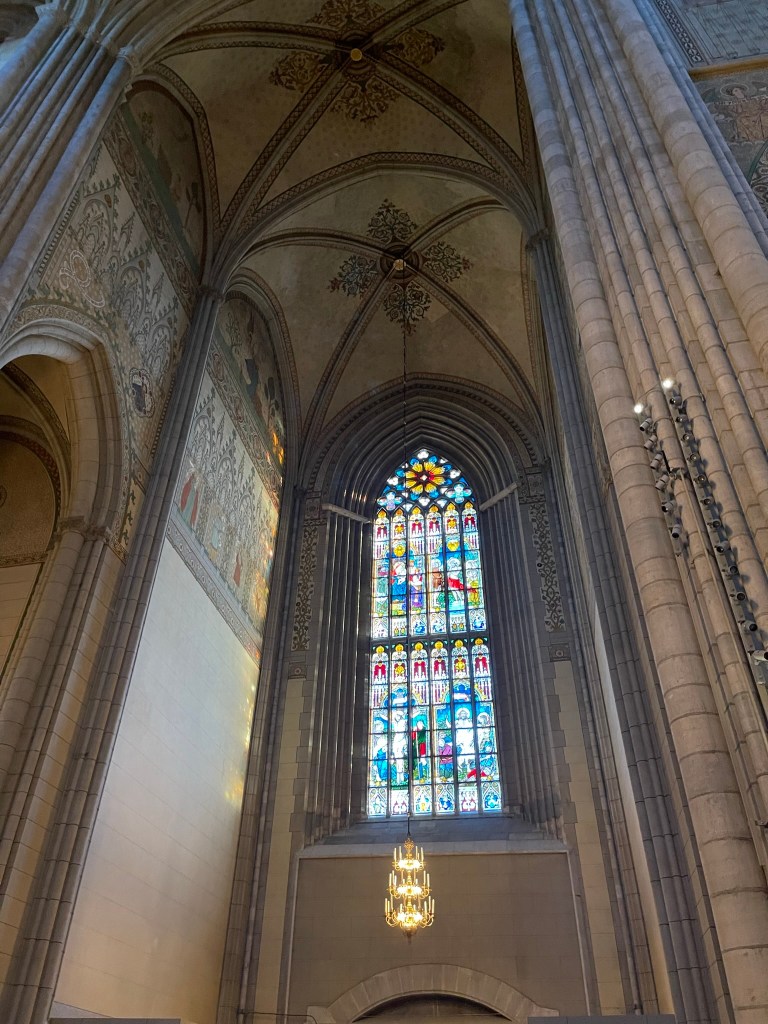
Till vänster: Abel offrar till Gud. Under: Gustav Vasa // Left: Abel sacrifices to God. Under: Gustav VasaAbraham offrar sin son Isak. Under: Mose, Aron, Josua och Job // Abraham sacrifices his son Isaac. Below: Moses, Aaron, Joshua and JobMose med kopparormen i öknen. Under: Samuel, David, Salomo och Elias // Moses with the copper snake in the desert. Below: Samuel, David, Solomon and ElijahÄrkeängelns Mikaels strid mot Satan. Under: Gustav II Adolf // The Archangel Michael’s battle against Satan. Under: Gustav II AdolfSveriges största kyrkfönster, Sonens eller befriarens fönster, kallas också Stora glas och mäter 18 x 7 meter samt har en glasytan på 50 kvm. Överst: Maria med barnet i knäet, till höger Johannes döparen döper Jesus. Vapensköldarna under: ärkestiftets (röd sköld med silverkors), Sveas (blått vapen med Tre kronor), Götas (riks-/folkungalejonet) och Uppsalas (lejon på blå botten). Nedanför: Golgatascen med korsfästelsen, till höger den uppståndne Kristus. Vapensköldarna under: ärkebiskop Folke Ängels, Vasas (med kärven), Stockholms (med Sankt Erik) och släkten Sparres. // Sweden’s largest church window, the Son’s or liberator’s window, is also called Large glass and measures 18 x 7 meters and has a glass surface of 50 sqm. Above: Mary with the child in her lap, on the right John the Baptist baptizes Jesus. The coats of arms below: the archdiocese’s (red shield with silver cross), Svea’s (blue coat of arms with three crowns), Göta’s (the national / Folkunga lion) and Uppsala’s (lion on a blue background). Below: The Calvary scene with the crucifixion, to the right the risen Christ. The coats of arms below: Archbishop Folke Ängel’s, Vasa’s (with the sheaf), Stockholm’s (with Sankt Erik) and the Sparre family’s.
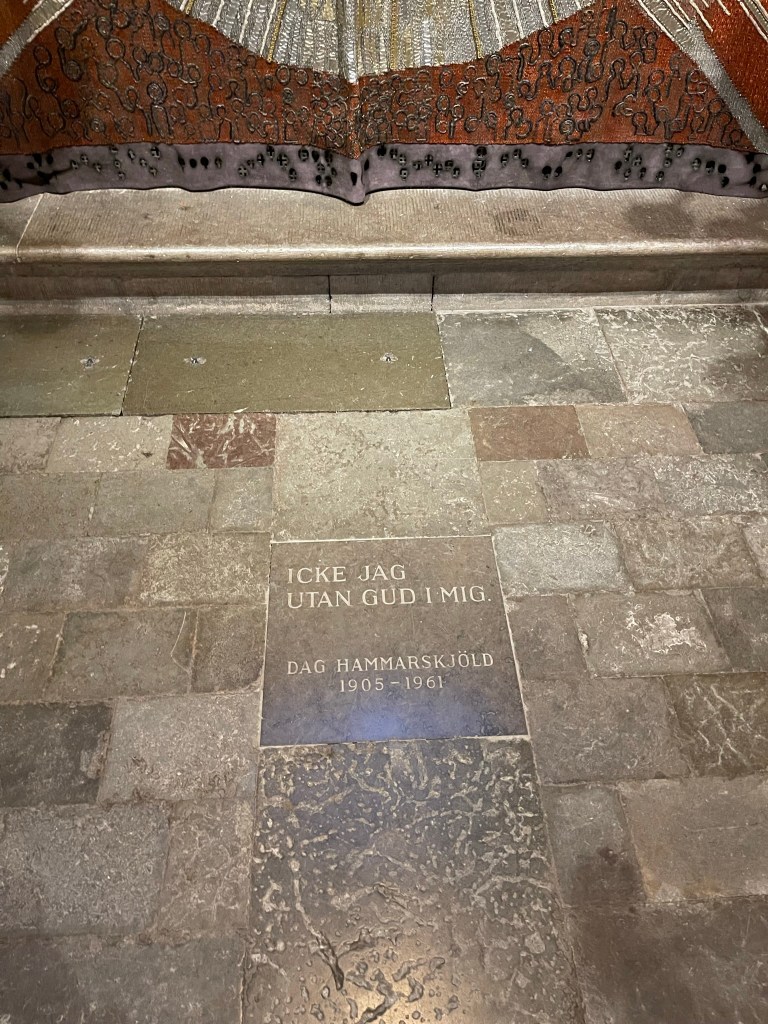
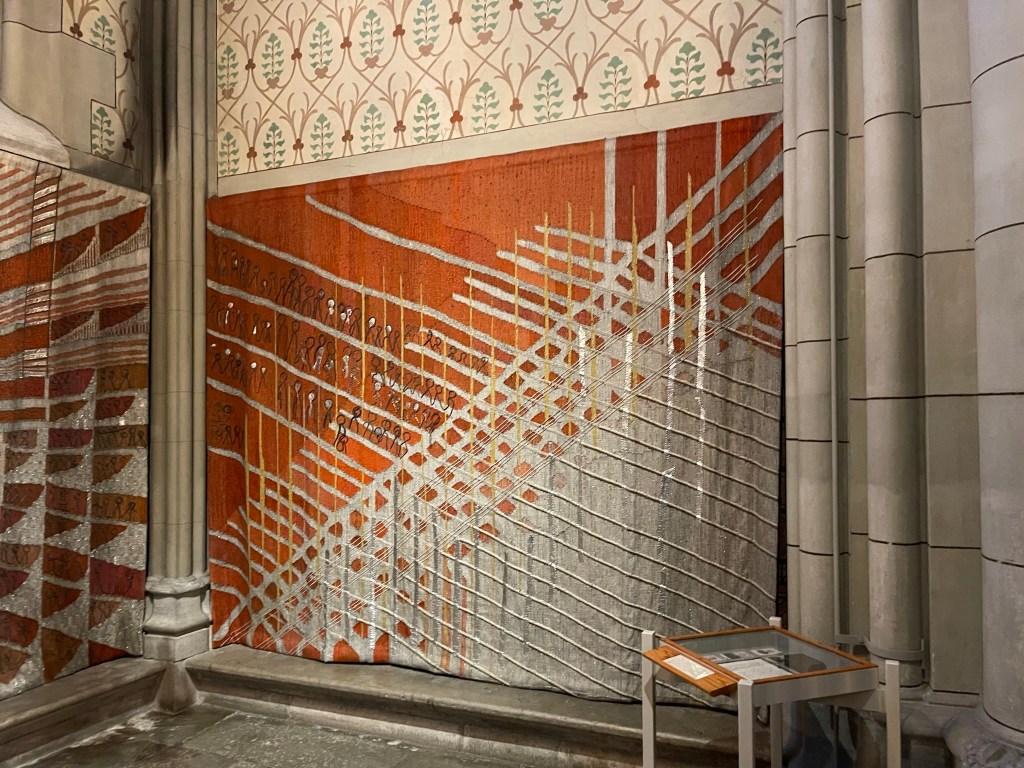
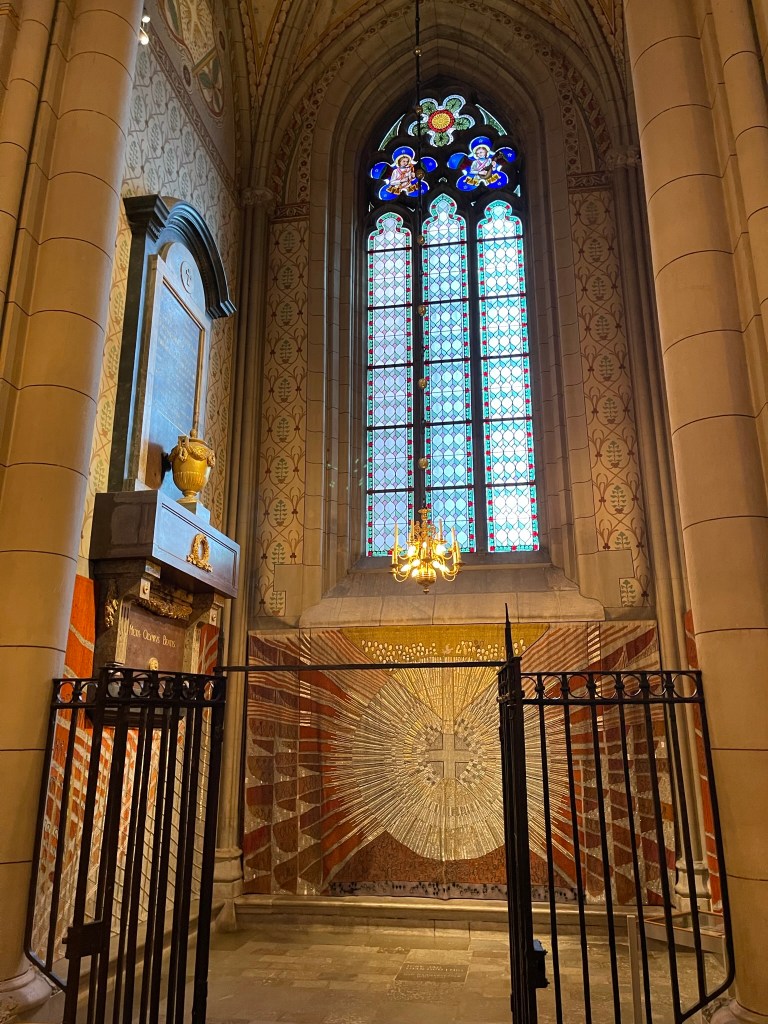
Fredens kapell var under medeltiden själakor, centrum för domkyrkans diakoni (socialt arbete). Dess skapande inspirerades av ärkebiskop Nathan Söderbloms (1866-1931) och FN:s generalsekreterare Dag Hammarskjölds (1905-1961) internationella arbete.
During the Middle Ages, the Chapel of Peace was the alms choir, the center of the cathedral's diakonia (social work). Its creation was inspired by the international work of Archbishop Nathan Söderblom (1866-1931) and UN Secretary-General Dag Hammarskjöld (1905-1961).
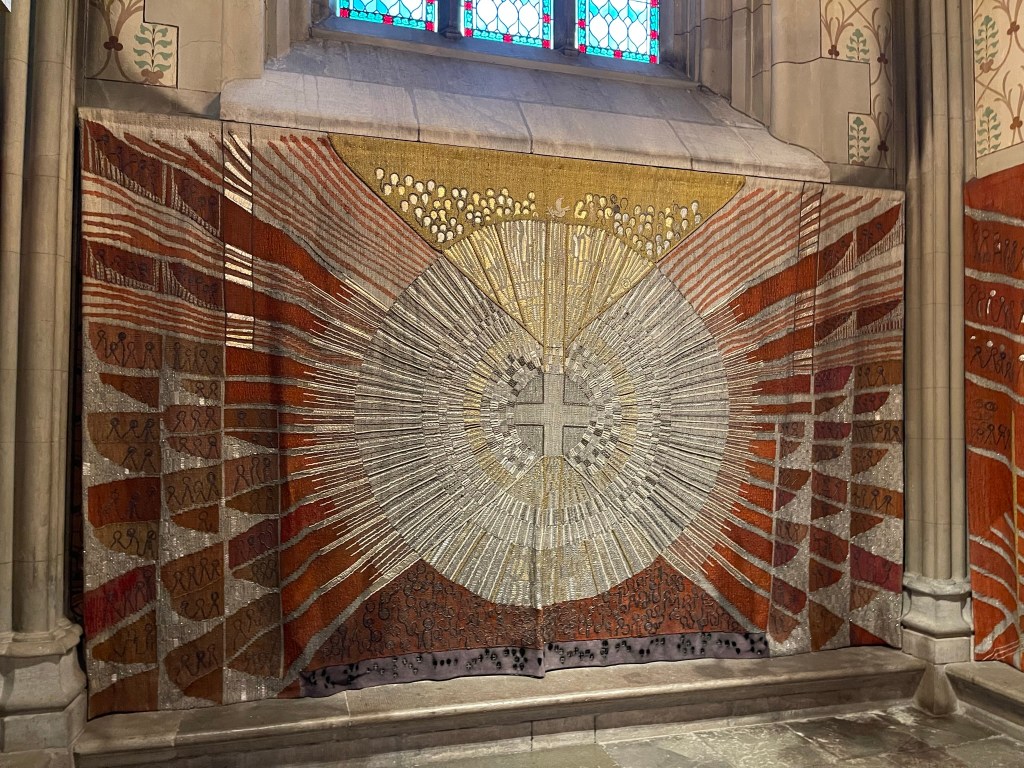
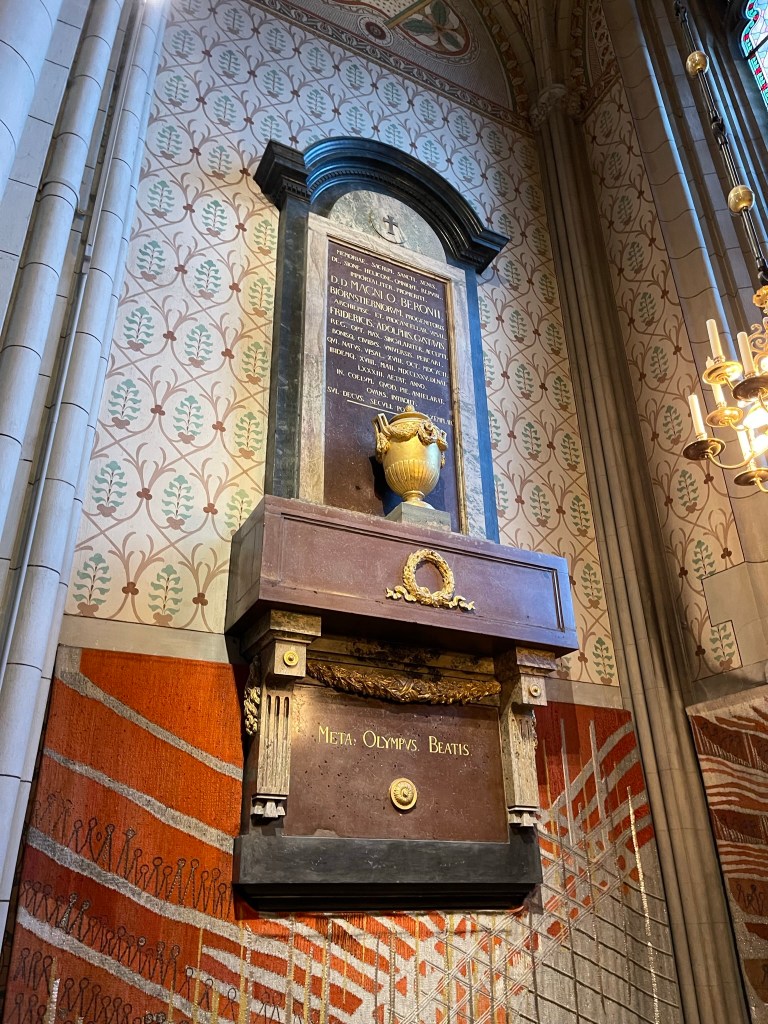
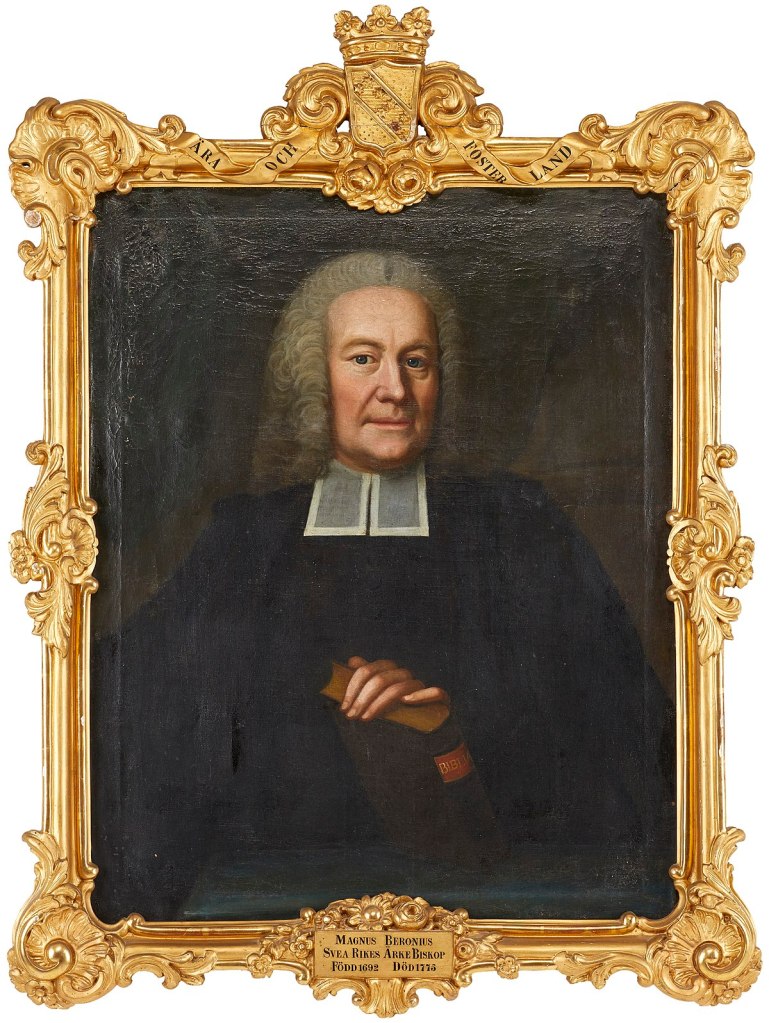
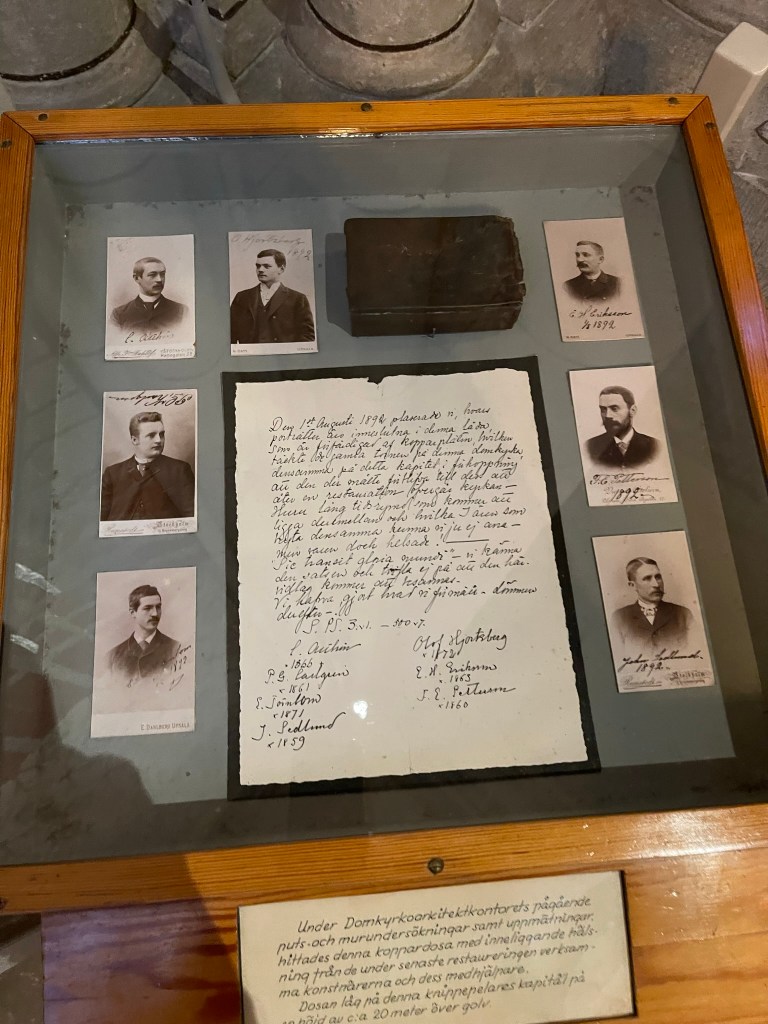
Dag Hammarskjöld-citat från 2005 // Dag Hammarskjöld quote from 2005Textil i rölakanteknik av Anna-Lisa Odelqvist-Kruse med freden som tema (utgångspunkt i psalm 102:3). Den runda formen symboliserar jorden med korset i centrum där strålar utgår ifrån och ovanför vilka små figurer symboliserande människor av olika folkslag vandrar inåt. En fredsduva med en olivkvist i näbben syns ovanför människorna. // Textile in rölakan technique by Anna-Lisa Odelqvist-Kruse with peace as the theme (starting point in Psalm 102: 3). The round shape symbolizes the earth with the cross in the center where rays start from and above which small figures symbolizing different kinds och people walk inwards. A dove of peace with an olive branch in its beak can be seen above the people.Odelqvist-Kruse. Källa // Source: WikipediaMinnestavla över ärkebiskop Magnus Beronius (1692-1775) // Memorial plaque to Archbishop Magnus Beronius (1692-1775)Källa // Source: WikipediaLars Bergenhielms (d. 1671) vapen // Lars Bergenhielm’s (d. 1671) coat of armsDen buckliga lilla asken av kopparplåt hittades under reparationsarbetena 1964 tjugo meter ovanför golvet, på pelarens kapitäl. Inuti fanns ett brev daterat 1892, skrivet av den då 26-årige konstnären Caleb Althin, samt sju porträttfotografier av de män som arbetade med målningarna. De skriver ”vi hafva gjort hvad vi förmått – dömen därefter”. // The dented little box of copper sheet was found during the repair work in 1964 twenty meters above the floor, on the capital of the pillar. Inside was a letter dated 1892, written by the then 26-year-old artist Caleb Althin, as well as seven portrait photographs of the men who worked on the paintings. They write ”we have done what we could – the judgment after that”.
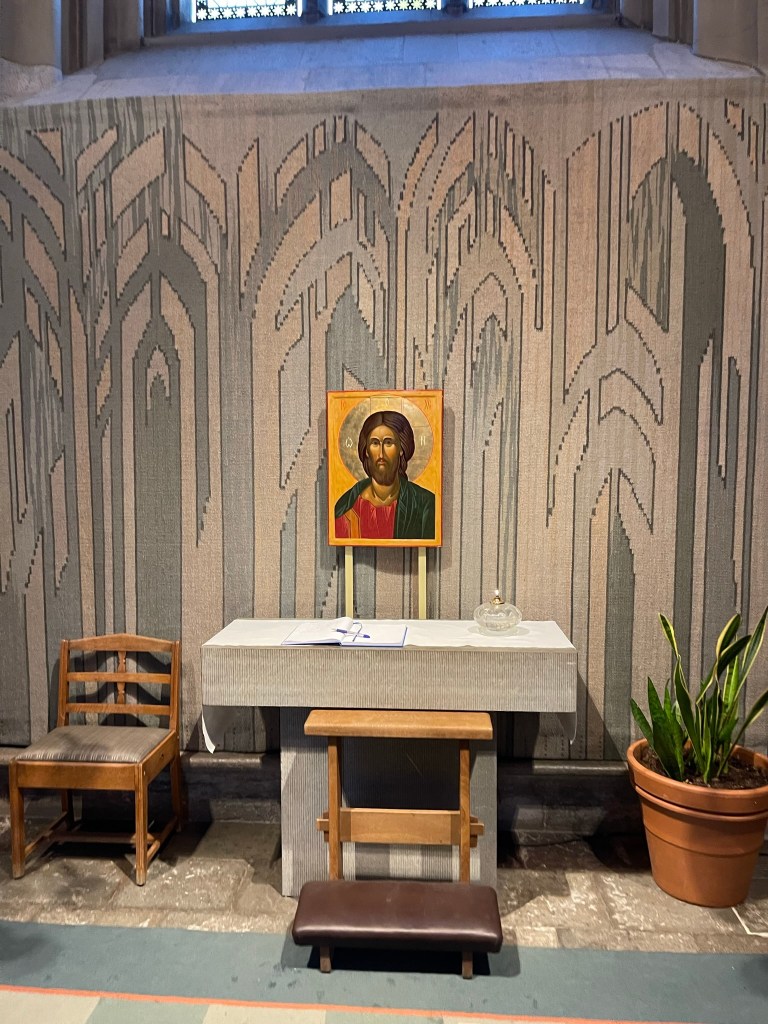
Bönens kapell var troligen Sigfrids och Mattias kor under medeltiden. Idag utgör kapellet ett rum för bön och meditation skapat av Britta Rendahl-Ljusterdal (f. 1927), med levande klätterväxter.
The Prayer's Chapel was probably Sigfrid's and Mattias' choir during the Middle Ages. Today, the chapel is a room for prayer and meditation created by Britta Rendahl-Ljusterdal (b. 1927), with living climbing plants.
Textilen ”Under gotiska bågar” av Rendahl-Ljusterdal, gjord i rölakanteknik. // The textile ‘Under Gothic arches’ by Rendahl-Ljusterdal, made in rölakan technique.Rendahl-Ljusterdal. Källa // Source: WikipediaKristusikon införskaffad 1991 och målad av den ryska nunnan moder Tamara i Moskva. Man kan skriva ner sina böner och tankar i förbönsboken. // Christ icon acquired in 1991 and painted by the Russian nun mother Tamara in Moscow. You can write down your prayers and thoughts in the prayer book.Minnestavla över slottsfogden Engelbrekt Svensson (d. 1673) // Memorial plaque over the bailiff Engelbrekt Svensson (d. 1673)Åke Hansson Ulfsparre af Broxviks huvudbaner // Åke Hansson Ulfsparre of Broxvik’s standard
The Crown of Thorns “The Crown of Thorns Reveals to us the Evil of Venial Sin.” from Revelations or Effusions of the Heart of Jesus by Father Alexis LeFebvre. . ‘Plectentes coronam de spinis, posuerunt super caput ejus.’ ‘And platting a crown of thorns, they put it upon His head’ (Matt. xxvii. 29). . The crowning with thorns was one of the most cruel sufferings and bloody outrages endured by Jesus Christ on the day of His dolours and death. Both blood and tears were in the eyes of that meek Saviour when, with a reed in His hand, He silently and lovingly gazed on the soldiers and executioners, who, as they passed, bent the knee before Him, saying insultingly, ‘Hail, King of the Jews!’ . But a crown of thorns around a heart! Can we conceive greater suffering, and what means this mystery of pain and love? I will give them a Heart to know Me. Let us repeat this touching text: ‘I will give them a Heart, My Heart, and they shall understand,’ We have already learned from the Cross of this Divine Heart what mortal sin is; the thorns of this crown are a figure of venial sin, those slight and numerous faults for which idle and cowardly souls forgive themselves, alas, but too readily, for they wound and tear the Heart of Jesus. . This is, doubtless, a most important and necessary subject for those who will some day read this book. The habit of small faults is an immense danger, and causes the death of souls by that sad slow malady called tepidity, which is a most difficult subject to treat of. I tremble to say too much, lest any faithful, and at the same time fearful, souls, who may apply these words to themselves, should be alarmed or discouraged; but far more do I fear saying too little on this subject, and so leaving many others to sleep in death. . O Sacred Heart of Jesus, thou hast promised to heal all hearts, even those that are tepid and lukewarm; be Thou our strength and light; we can never have greater need of thy grace, never have we more confidently invoked it! We shall, then, . I. Examine the signs or symptoms of this malady. . II. Study its character or nature. III. Point out the remedies. . I. A few words will suffice to enlighten the welldisposed soul ; for there are certain signs by which the malady and its dangers are made evident; thus, the habit one has of committing venial sins ; the frequency of these slight faults, and above all an habitual contempt of little things—I mean small graces, or rather, small infidelities; habitual negligence in all that concerns the service of God, such as prayer and receiving the Sacraments; disgust, ennui, and routine in pious exercises; and above all when there is scarcely any resistance or struggle before committing a fault, and but little remorse or repentance afterwards. All these are alarming symptoms, and may well cause you to fear. If you are not already struck with this malady, you are certainly threatened with it; already have you plunged many of these thorns into the Heart of your God ; you have wounded Him by all these infidelities. . But there is no thorn that tears this Heart more cruelly than a divided soul, which gives itself but partially, fighting continually against His love, refusing Him almost every sacrifice. As if it were possible to reconcile the Gospel with the world, or to mingle heaven and earth! Jesus could not endure a soul in such a state, and would not remain with it; it would disgust Him; He would soon reject it, and cast it out of His Heart. And mark this well : the more the graces received, the more alarming are the symptoms, and the more is death to be feared. Yet, again, do you understand what it is that makes this state so sad, and the contrast between the two hearts so horrible? The one burns with love, devoured by the flames of the most ardent charity ; the other is tepid and languid, what do I say? it is cold, and will soon be frozen in death! Dead from the very heart! . II. Let us now study the characteristics of this sad malady, and at once declare it to be, not only a condition of pain, but replete with danger. . These divided souls and weak hearts generally suffer much; for God is not pleased, nor can He be; then He complains, He often threatens, and sometimes strikes. He complains; and thenceforward there is not the same confiding intercourse. He is resisted, and can no longer give His peace. Who that resists Him can have peace? The soul withdraws from Him, and then His light becomes less, and finally disappears. He threatens: I will place, He says, thorns in all his paths; the malediction of the Lord is ready to fall upon him who fights his battles with cowardice, and who negligently performs the Lord’s work. ‘Cursed be he that doth the work of the Lord deceitfully’ (Jer. xlviii. 10). At last He strikes, and sometimes with heavy blows of justice; He makes His thunderbolts fall upon these ungrateful children to rouse them from their sleep of death, unless some day, fully disgusted, He holds His peace, and flees away, which is incomparably more fatal for the soul, which is thus left to die. All these, and the following verities, are of faith, reason, and experience. God has said, and you also know, dear reader, that you have never been really happy in the service of God, except when you have been faithful and generous. . But it is time for us to enter upon the terrors of this subject, and to speak of the dangerous character of this sad malady of tepidity, which infallibly leads to the death of souls—yes, infallibly; but—and this is what appears to me so terrifying—it leads the soul very gently on to this fatal termination: Paulatim, by little and little, says the Holy Spirit, and so imperceptibly that a soul may be really dead, and yet preserve the appearance of life. Three kinds of paths or descents lead to this abyss, all so rapid and imperceptible, that the progress, or rather the fall, is scarcely observed. This explanation is necessary for the comprehension of two sentences which seem to contradict each other. God says, they shall fall little by little, very gently: ‘He that contemneth small things shall fall by little and little’ (Eccles. xix. 1). St. Bernard says, ‘They begin by small things, trifling faults, and soon are carried away,are precipitated into great ones, and then into crime, because the descent is gentle and rapid at the same time.’ . The path of illusion is one of the ways by which the soul goes to its death. Self-deception is so easy. What! when even the science of theology is not always sufficient for a priest to be able to pronounce whether the sin of which you accuse yourself is mortal or venial; and yet you do not fear to decide in your own favour! Nevertheless there is not a great distance between a thought negligently resisted and the commencement of complaisance, or even of guilty desire; not so great a distance as you may imagine between a look of imprudent curiosity and one of impurity. ‘Fear then: thou hast the name of being alive, and thou art dead’ (Apoc. iii. 1). Yes, perhaps even now you are dead, and at the bottom of the abyss! . Another path is that by which the soul is drawn away. This fatal habit of easy indifference, this life of self-indulgence and concession, ends by overcoming the will. There is first a force which lessens the attraction to what is good, and an influence augmenting the attraction of evil; then a day comes when the measure of evil is full, and the soul is crushed under the weight of a thousand trifling faults, which, though considered to be but trifles, are sufficient by their frightful accumulation to destroy its life; there is no courage to resist the supreme effort of the perfidious enemy, who only waited for this day and hour to give battle and to triumph. You will understand I do not not say that venial sins will in the end become mortal; ordinarily this would not be true, though i t is certain that in matters of justice they might in some cases impose an obligation sub gravi, and form a grave matter or crime, and consequently a mortal sin. I mean merely -to say that generally the soul enchained by the force of habit finds itself gently, but surely, conducted by this path of attraction to death—that is to say, to mortal sin. Finally, there is the road of divine justice or chastisement. Wounded and outraged by all these resistances to grace, wounded and outraged in His love by all these infidelities and faults, God is at last exhausted, even His Heart is filled with disgust. At first He is silent; He withdraws Himself, He abandons and even curses this soul; and then—the terrible word must be said—He rejects, and finally vomits it: ‘Because thou art lukewarm, I will begin to vomit thee out of My mouth’ (Apoc. iii. 16). O misery! Destiny a thousand times more sad in one sense than that of the sinner! Jesus wishes not for his death, but that he might return to life. Comprehend, then, my dear reader, the difference. If you are a sinner, Jesus Christ pities you; He opens His Heart to you, and will shed tears of compassion over you, and the treasure of His merciful pity. Weep, and He will pardon you ; but if you continue tepid, He cannot endure you; you disgust Him; He will vomit you forth out of His mouth. ‘I will begin to vomit thee;’ and perhaps this has already begun. ‘I would thou wert cold or hot. But because thou art lukewarm, I will begin to vomit thee out of My mouth’ (Apoc. iii. 16). . To vomit! This is the terrible word which I cannot write without trembling, and which I had even rather not attempt to explain here, for fear of plunging some soul into despair. I will, then, merely ask when and how Jesus Christ could return, and take back this soul which He had once vomited forth with disgust? I wish to know if there is anything by which the soul can be roused from this death-sleep or restored to life. Would good reading effect this? We know that many sinners have been converted by reading good books—St. Augustine, Ignatius Loyola, and many others we could name; but have you ever seen or heard of this effect upon a tepid soul? Would confession be likely to rouse it? Alas, a tepid soul prepares itself without care, and approaches this Sacrament unconcernedly, not even understanding what the priest says! Would Holy Communion effect it? On the contrary, most certainly a tepid Communion would consummate the evil, and the soul would sink into an abyss of sin and death. Would, then, the Holy Scriptures, which are searching, efficacious, and penetrating, and by which God has often worked wonders, be the means of restoring this soul to life? Alas, it is rarely, indeed, that lukewarm souls are touched by the Holy Word, for they have ears and hear not. . It may be truly said that nothing can arrest them when once they begin to descend into the abyss; nothing can raise them when once they have fallen; nothing restore them to life when they are dead. ‘I would thou wert cold!’ . Yet, further, mark the difference. I will suppose a fervent soul finds itself a prey to sudden and horrible temptation. If it yields and begins to fall, it is alarmed, and immediately asks whither it is going, and prays its guardian angel to arrest and protect it. Startled and aroused even by the shock of its fall, it sorrowfully asks where it is, and cries from the bottom of the abyss to God to have pity. ‘Out of the depths have I called to Thee, O Lord.’ But the tepid soul, on the contrary, which gradually, imperceptibly descends, never stops to inquire whither it is going, or where it is. The barren tree is fallen, is dead! Is there not every reason to fear that as it falls, so it will lie? But enough, O my God ; perhaps even too much for more than one soul; and how do I tremble lest in these words I may have written my own sentence! Let us, then, hasten to say there is yet a remedy, and that we must never cease to hope. . III. Yes, you can be healed, if you wish, and I am about to point out two remedies, which are as infallible as they appear mild and easy. Do you really wish for them? Will you be made whole? The first, then, is prayer; above all, prayer to the Sacred Heart of Jesus. He has promised to save and heal all who invoke Him with confidence, even tepid souls : a spark of love, or a tear shed over you, will recall you to life. Say to Him, then, ‘O my Jesus, he whom Thou lovest is sick’ (John xi. 3); ‘O my God, I die !’ and He will have pity on you, and will restore you the strength and joy of the years of your first fervour. Have confidence; cast yourself into this Divine Heart. . The second remedy is even more simple, easy, and prompt: it is action, or sacrifice. You will try to conquer yourself, and will at once commence by a little sacrifice. You will gain a victory over yourself by restraining your lips even from one useless word, or by repressing the idle curiosity of a look in walking in the streets or in the church. You will make this sacrifice to-day in honour of the Heart of Jesus, and He will recompense you by the peace and joy of His love. To-morrow offer Him two sacrifices, two equally easy victories; then three, and four. Thus you will go on for several days, and there will be a proportionate increase of peace, love, and joy in your hearts. I assure you that not only will you be healed, but you will live joyfully for His glory, and you will live to die no more. Thus each day you will remove some of those thorns which wound His Heart, and this grateful and faithful God will daily bestow upon you a more abundant portion of life and grace. ‘That they may have it more abundantly’ (John x. 10). 1st Sunday of Lent, the temptation of Christ in the desert. From St. Augustine: “Our pilgrimage on earth cannot be exempt from trial. We progress by means of trial. No one knows himself except through trial, or receives a crown except after victory, or strives except against an enemy or temptations. The one who cries from the ends of the earth is in anguish, but is not left on his own. Christ chose to foreshadow us, who are his body, by means of his body, in which he has died, risen and ascended into heaven, so that the members of his body may hope to follow where their head has gone before.” https://fb.watch/bAeWZw9X0i/https://www.youtube.com/watch?v=WHgLp2HPUO4
Albertus Magnus 40t968S00 cp1moisnor7074d3 · Likt den mänskliga tomheten bara har det yttre, det världsliga att förhålla sig till, har ondskan blott makt i fokus. Förmågan att förvilla och korrumpera det mänskliga, inklusive föröda det vackra, är ondskans enda triumf. Därutöver finns bara en banal, ljum likgiltighet; likt spindeln som vajande sitter i väntan medan brisen sakta blåser genom fångstnätet. Det demoniska uppskattar när vi människor träter. Den privatägda politiken och de massmediala gestaltningarna har sjunkit så lågt att de utgör ett slags konfliktacceleratorer med en ständig sekvens av oroväckande eländen som pest och hungersnöd, samt krig och världsbrand. Effekten går före verklighetsförankringen. Effekten blir vanföreställningar och rädsla som splittrar. Det är inte för inte som världens furste även kallas den store splittraren. Även Hollywood-hemskheter hetsar oss till att tro att ondskan bara kommer i skenande stereotyper som rasande rymdskräcködlor, galna yxmördare och dånande bombflyg. Som om ondskan vore dum i huvudet. Det är den inte. Den är högst beräknande och slug, samt tar ofta till de bakdörrar som vi inte känner till. Första blåsningen var att dupera folk i gemen att ondskan inte ens finns. Reservblåsningen är att om ondskans hantlangare väl skulle komma, är den blott så skräckinjagande övertydlig att ingenting annat är att befara. Flugornas herre vet att lämna flugorna hemma när det skall ut och snärjas, förföras och vilseledas. Ondskan är lika charmig, snygg och rolig som den mest slipade sol-och-vårare; eller vardagsgrå, lagom bortkommen och harmlös som en svensk statsminister. Ingenting som skrämmer. Ingenting som väcker anstöt. Ibland tvärtom: ”Satan själv förklär sig till en ljusets ängel.” [2 Kor 11:14] Ondskans agn är frestelsen. Om vi faller för frestelsen sjunker syndakroken in och rycker oss till fall. Fastetiden kan lära oss hur man håller emot och stärker sin självbehärskning. Vi lär oss också att se upp med lögnen, även när uttalad som skenbart vänlig och omtänksam (Matt 16:22-23). Lögnens fader (Joh 8:44) företräder ett imperium av lögner, bedrägeri och förstörelse, med en strävan efter oförtjänt makt eller kunskap på bekostnad av andras välbefinnande och liv. Vi har tillåtit oss själva att fördummas. Vi har själva ansvar för att återfinna Sanningen och inte låta oss vilseledas (Luk 21:8). Språket är vägen ut ur detta förfall och nyckeln till en sund skepsis och kritiskt tänkande (jmf. 1 Joh 4:1-6). Fr. Albertus Magnus Nordisk-katolska kyrkan i Karlskrona, Sankt Nikolaus. Första Söndagen i Den Stora Fastan: Kampen mot frestelser. Läsningar: 1 Mos 4:3-7; Hebr 4:14-16; Matt 16:21-23.













 Discover Sweden with Alex
intressant blogg GUD välsigne dig intresant blogg _https://fb.watch/bAeWZw9X0i/
https://fb.watch/bAeWZw9X0i/
The Crown of Thorns “The Crown of Thorns Reveals to us the Evil of Venial Sin.” from Revelations or Effusions of the Heart of Jesus by Father Alexis LeFebvre. . ‘Plectentes coronam de spinis, posuerunt super caput ejus.’ ‘And platting a crown of thorns, they put it upon His head’ (Matt. xxvii. 29). . The crowning with thorns was one of the most cruel sufferings and bloody outrages endured by Jesus Christ on the day of His dolours and death. Both blood and tears were in the eyes of that meek Saviour when, with a reed in His hand, He silently and lovingly gazed on the soldiers and executioners, who, as they passed, bent the knee before Him, saying insultingly, ‘Hail, King of the Jews!’ . But a crown of thorns around a heart! Can we conceive greater suffering, and what means this mystery of pain and love? I will give them a Heart to know Me. Let us repeat this touching text: ‘I will give them a Heart, My Heart, and they shall understand,’ We have already learned from the Cross of this Divine Heart what mortal sin is; the thorns of this crown are a figure of venial sin, those slight and numerous faults for which idle and cowardly souls forgive themselves, alas, but too readily, for they wound and tear the Heart of Jesus. . This is, doubtless, a most important and necessary subject for those who will some day read this book. The habit of small faults is an immense danger, and causes the death of souls by that sad slow malady called tepidity, which is a most difficult subject to treat of. I tremble to say too much, lest any faithful, and at the same time fearful, souls, who may apply these words to themselves, should be alarmed or discouraged; but far more do I fear saying too little on this subject, and so leaving many others to sleep in death. . O Sacred Heart of Jesus, thou hast promised to heal all hearts, even those that are tepid and lukewarm; be Thou our strength and light; we can never have greater need of thy grace, never have we more confidently invoked it! We shall, then, . I. Examine the signs or symptoms of this malady. . II. Study its character or nature. III. Point out the remedies. . I. A few words will suffice to enlighten the welldisposed soul ; for there are certain signs by which the malady and its dangers are made evident; thus, the habit one has of committing venial sins ; the frequency of these slight faults, and above all an habitual contempt of little things—I mean small graces, or rather, small infidelities; habitual negligence in all that concerns the service of God, such as prayer and receiving the Sacraments; disgust, ennui, and routine in pious exercises; and above all when there is scarcely any resistance or struggle before committing a fault, and but little remorse or repentance afterwards. All these are alarming symptoms, and may well cause you to fear. If you are not already struck with this malady, you are certainly threatened with it; already have you plunged many of these thorns into the Heart of your God ; you have wounded Him by all these infidelities. . But there is no thorn that tears this Heart more cruelly than a divided soul, which gives itself but partially, fighting continually against His love, refusing Him almost every sacrifice. As if it were possible to reconcile the Gospel with the world, or to mingle heaven and earth! Jesus could not endure a soul in such a state, and would not remain with it; it would disgust Him; He would soon reject it, and cast it out of His Heart. And mark this well : the more the graces received, the more alarming are the symptoms, and the more is death to be feared. Yet, again, do you understand what it is that makes this state so sad, and the contrast between the two hearts so horrible? The one burns with love, devoured by the flames of the most ardent charity ; the other is tepid and languid, what do I say? it is cold, and will soon be frozen in death! Dead from the very heart! . II. Let us now study the characteristics of this sad malady, and at once declare it to be, not only a condition of pain, but replete with danger. . These divided souls and weak hearts generally suffer much; for God is not pleased, nor can He be; then He complains, He often threatens, and sometimes strikes. He complains; and thenceforward there is not the same confiding intercourse. He is resisted, and can no longer give His peace. Who that resists Him can have peace? The soul withdraws from Him, and then His light becomes less, and finally disappears. He threatens: I will place, He says, thorns in all his paths; the malediction of the Lord is ready to fall upon him who fights his battles with cowardice, and who negligently performs the Lord’s work. ‘Cursed be he that doth the work of the Lord deceitfully’ (Jer. xlviii. 10). At last He strikes, and sometimes with heavy blows of justice; He makes His thunderbolts fall upon these ungrateful children to rouse them from their sleep of death, unless some day, fully disgusted, He holds His peace, and flees away, which is incomparably more fatal for the soul, which is thus left to die. All these, and the following verities, are of faith, reason, and experience. God has said, and you also know, dear reader, that you have never been really happy in the service of God, except when you have been faithful and generous. . But it is time for us to enter upon the terrors of this subject, and to speak of the dangerous character of this sad malady of tepidity, which infallibly leads to the death of souls—yes, infallibly; but—and this is what appears to me so terrifying—it leads the soul very gently on to this fatal termination: Paulatim, by little and little, says the Holy Spirit, and so imperceptibly that a soul may be really dead, and yet preserve the appearance of life. Three kinds of paths or descents lead to this abyss, all so rapid and imperceptible, that the progress, or rather the fall, is scarcely observed. This explanation is necessary for the comprehension of two sentences which seem to contradict each other. God says, they shall fall little by little, very gently: ‘He that contemneth small things shall fall by little and little’ (Eccles. xix. 1). St. Bernard says, ‘They begin by small things, trifling faults, and soon are carried away,are precipitated into great ones, and then into crime, because the descent is gentle and rapid at the same time.’ . The path of illusion is one of the ways by which the soul goes to its death. Self-deception is so easy. What! when even the science of theology is not always sufficient for a priest to be able to pronounce whether the sin of which you accuse yourself is mortal or venial; and yet you do not fear to decide in your own favour! Nevertheless there is not a great distance between a thought negligently resisted and the commencement of complaisance, or even of guilty desire; not so great a distance as you may imagine between a look of imprudent curiosity and one of impurity. ‘Fear then: thou hast the name of being alive, and thou art dead’ (Apoc. iii. 1). Yes, perhaps even now you are dead, and at the bottom of the abyss! . Another path is that by which the soul is drawn away. This fatal habit of easy indifference, this life of self-indulgence and concession, ends by overcoming the will. There is first a force which lessens the attraction to what is good, and an influence augmenting the attraction of evil; then a day comes when the measure of evil is full, and the soul is crushed under the weight of a thousand trifling faults, which, though considered to be but trifles, are sufficient by their frightful accumulation to destroy its life; there is no courage to resist the supreme effort of the perfidious enemy, who only waited for this day and hour to give battle and to triumph. You will understand I do not not say that venial sins will in the end become mortal; ordinarily this would not be true, though i t is certain that in matters of justice they might in some cases impose an obligation sub gravi, and form a grave matter or crime, and consequently a mortal sin. I mean merely -to say that generally the soul enchained by the force of habit finds itself gently, but surely, conducted by this path of attraction to death—that is to say, to mortal sin. Finally, there is the road of divine justice or chastisement. Wounded and outraged by all these resistances to grace, wounded and outraged in His love by all these infidelities and faults, God is at last exhausted, even His Heart is filled with disgust. At first He is silent; He withdraws Himself, He abandons and even curses this soul; and then—the terrible word must be said—He rejects, and finally vomits it: ‘Because thou art lukewarm, I will begin to vomit thee out of My mouth’ (Apoc. iii. 16). O misery! Destiny a thousand times more sad in one sense than that of the sinner! Jesus wishes not for his death, but that he might return to life. Comprehend, then, my dear reader, the difference. If you are a sinner, Jesus Christ pities you; He opens His Heart to you, and will shed tears of compassion over you, and the treasure of His merciful pity. Weep, and He will pardon you ; but if you continue tepid, He cannot endure you; you disgust Him; He will vomit you forth out of His mouth. ‘I will begin to vomit thee;’ and perhaps this has already begun. ‘I would thou wert cold or hot. But because thou art lukewarm, I will begin to vomit thee out of My mouth’ (Apoc. iii. 16). . To vomit! This is the terrible word which I cannot write without trembling, and which I had even rather not attempt to explain here, for fear of plunging some soul into despair. I will, then, merely ask when and how Jesus Christ could return, and take back this soul which He had once vomited forth with disgust? I wish to know if there is anything by which the soul can be roused from this death-sleep or restored to life. Would good reading effect this? We know that many sinners have been converted by reading good books—St. Augustine, Ignatius Loyola, and many others we could name; but have you ever seen or heard of this effect upon a tepid soul? Would confession be likely to rouse it? Alas, a tepid soul prepares itself without care, and approaches this Sacrament unconcernedly, not even understanding what the priest says! Would Holy Communion effect it? On the contrary, most certainly a tepid Communion would consummate the evil, and the soul would sink into an abyss of sin and death. Would, then, the Holy Scriptures, which are searching, efficacious, and penetrating, and by which God has often worked wonders, be the means of restoring this soul to life? Alas, it is rarely, indeed, that lukewarm souls are touched by the Holy Word, for they have ears and hear not. . It may be truly said that nothing can arrest them when once they begin to descend into the abyss; nothing can raise them when once they have fallen; nothing restore them to life when they are dead. ‘I would thou wert cold!’ . Yet, further, mark the difference. I will suppose a fervent soul finds itself a prey to sudden and horrible temptation. If it yields and begins to fall, it is alarmed, and immediately asks whither it is going, and prays its guardian angel to arrest and protect it. Startled and aroused even by the shock of its fall, it sorrowfully asks where it is, and cries from the bottom of the abyss to God to have pity. ‘Out of the depths have I called to Thee, O Lord.’ But the tepid soul, on the contrary, which gradually, imperceptibly descends, never stops to inquire whither it is going, or where it is. The barren tree is fallen, is dead! Is there not every reason to fear that as it falls, so it will lie? But enough, O my God ; perhaps even too much for more than one soul; and how do I tremble lest in these words I may have written my own sentence! Let us, then, hasten to say there is yet a remedy, and that we must never cease to hope. . III. Yes, you can be healed, if you wish, and I am about to point out two remedies, which are as infallible as they appear mild and easy. Do you really wish for them? Will you be made whole? The first, then, is prayer; above all, prayer to the Sacred Heart of Jesus. He has promised to save and heal all who invoke Him with confidence, even tepid souls : a spark of love, or a tear shed over you, will recall you to life. Say to Him, then, ‘O my Jesus, he whom Thou lovest is sick’ (John xi. 3); ‘O my God, I die !’ and He will have pity on you, and will restore you the strength and joy of the years of your first fervour. Have confidence; cast yourself into this Divine Heart. . The second remedy is even more simple, easy, and prompt: it is action, or sacrifice. You will try to conquer yourself, and will at once commence by a little sacrifice. You will gain a victory over yourself by restraining your lips even from one useless word, or by repressing the idle curiosity of a look in walking in the streets or in the church. You will make this sacrifice to-day in honour of the Heart of Jesus, and He will recompense you by the peace and joy of His love. To-morrow offer Him two sacrifices, two equally easy victories; then three, and four. Thus you will go on for several days, and there will be a proportionate increase of peace, love, and joy in your hearts. I assure you that not only will you be healed, but you will live joyfully for His glory, and you will live to die no more. Thus each day you will remove some of those thorns which wound His Heart, and this grateful and faithful God will daily bestow upon you a more abundant portion of life and grace. ‘That they may have it more abundantly’ (John x. 10). 1st Sunday of Lent, the temptation of Christ in the desert. From St. Augustine: “Our pilgrimage on earth cannot be exempt from trial. We progress by means of trial. No one knows himself except through trial, or receives a crown except after victory, or strives except against an enemy or temptations. The one who cries from the ends of the earth is in anguish, but is not left on his own. Christ chose to foreshadow us, who are his body, by means of his body, in which he has died, risen and ascended into heaven, so that the members of his body may hope to follow where their head has gone before.” https://fb.watch/bAeWZw9X0i/https://www.youtube.com/watch?v=WHgLp2HPUO4
Albertus Magnus 40t968S00 cp1moisnor7074d3 · Likt den mänskliga tomheten bara har det yttre, det världsliga att förhålla sig till, har ondskan blott makt i fokus. Förmågan att förvilla och korrumpera det mänskliga, inklusive föröda det vackra, är ondskans enda triumf. Därutöver finns bara en banal, ljum likgiltighet; likt spindeln som vajande sitter i väntan medan brisen sakta blåser genom fångstnätet. Det demoniska uppskattar när vi människor träter. Den privatägda politiken och de massmediala gestaltningarna har sjunkit så lågt att de utgör ett slags konfliktacceleratorer med en ständig sekvens av oroväckande eländen som pest och hungersnöd, samt krig och världsbrand. Effekten går före verklighetsförankringen. Effekten blir vanföreställningar och rädsla som splittrar. Det är inte för inte som världens furste även kallas den store splittraren. Även Hollywood-hemskheter hetsar oss till att tro att ondskan bara kommer i skenande stereotyper som rasande rymdskräcködlor, galna yxmördare och dånande bombflyg. Som om ondskan vore dum i huvudet. Det är den inte. Den är högst beräknande och slug, samt tar ofta till de bakdörrar som vi inte känner till. Första blåsningen var att dupera folk i gemen att ondskan inte ens finns. Reservblåsningen är att om ondskans hantlangare väl skulle komma, är den blott så skräckinjagande övertydlig att ingenting annat är att befara. Flugornas herre vet att lämna flugorna hemma när det skall ut och snärjas, förföras och vilseledas. Ondskan är lika charmig, snygg och rolig som den mest slipade sol-och-vårare; eller vardagsgrå, lagom bortkommen och harmlös som en svensk statsminister. Ingenting som skrämmer. Ingenting som väcker anstöt. Ibland tvärtom: ”Satan själv förklär sig till en ljusets ängel.” [2 Kor 11:14] Ondskans agn är frestelsen. Om vi faller för frestelsen sjunker syndakroken in och rycker oss till fall. Fastetiden kan lära oss hur man håller emot och stärker sin självbehärskning. Vi lär oss också att se upp med lögnen, även när uttalad som skenbart vänlig och omtänksam (Matt 16:22-23). Lögnens fader (Joh 8:44) företräder ett imperium av lögner, bedrägeri och förstörelse, med en strävan efter oförtjänt makt eller kunskap på bekostnad av andras välbefinnande och liv. Vi har tillåtit oss själva att fördummas. Vi har själva ansvar för att återfinna Sanningen och inte låta oss vilseledas (Luk 21:8). Språket är vägen ut ur detta förfall och nyckeln till en sund skepsis och kritiskt tänkande (jmf. 1 Joh 4:1-6). Fr. Albertus Magnus Nordisk-katolska kyrkan i Karlskrona, Sankt Nikolaus. Första Söndagen i Den Stora Fastan: Kampen mot frestelser. Läsningar: 1 Mos 4:3-7; Hebr 4:14-16; Matt 16:21-23.
GillaGilla